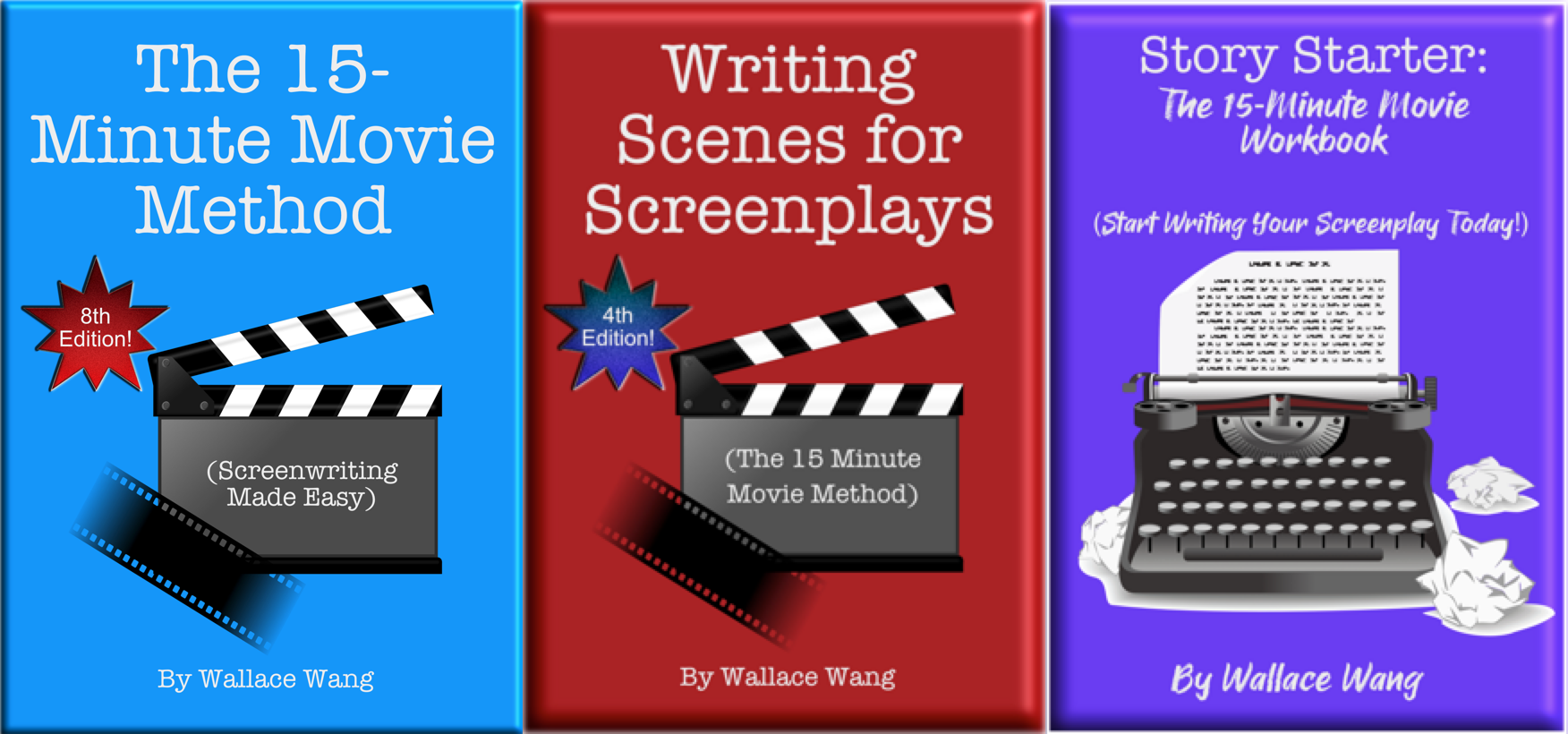
“The 15-Minute Movie Method” is Now Available as a Kindle and Nook E-Book!
What makes a great screenplay? It’s not just interesting characters, memorable dialogue, or explosive action scenes. What makes a great screenplay is a great story, and a great story follows a specific structure that can help shape your particular idea.
Taking all the information posted on this blog over the past two years, I’ve rearranged, organized, and rewritten the information into an Amazon Kindle and Nook e-book. You can find the same information on this web site, but the e-book provides a more structured approach to turning your good idea for a story into a well-structured story. “The 15-Minute Movie Method” is not about formulas but guidelines that successful movies follow to tell a compelling story from start to finish.
If you’ve always wanted to write a screenplay or a novel, you may be wondering, “What makes a great story?” It’s not just interesting characters, memorable dialogue, or explosive action scenes. What makes a great screenplay (or novel) is a great story.
Every great story, from classic novels and stage plays to today’s modern films, follow the same basic, proven story structure that alternates between contrasting problems and solutions to maintain and maximize suspense.
In the traditional three Act structure, a story looks like this:
Act I -- Exposition
Act II -- Rising Action
Act III -- Climax
Act I and Act III are roughly the same length (corresponding to a 30-minute length in a 120-minute screenplay), but Act II is typically twice as long as either Act I or Act III. The result is that the traditional three Act structure sets you up for failure by forcing you to write a huge chunk of your story without any guidelines whatsoever.
In contrast, a four Act structure makes each Act manageable while also providing the necessary contrast to create a compelling story. Stories are interesting and suspenseful because they alternate between problems facing the hero followed by solutions that the hero achieves. In the four Act structure, a story looks like this:
Act I -- Exposition
Act IIa -- Positive Rising Action
Act IIb -- Negative Rising Action
Act III -- Climax
Another way to look at this four part story structure is as follows:
Act I -- Problem facing the hero
Act IIa -- Hero solves the problem and appears to achieve success
Act IIb -- New problems occur
Act III -- Hero finally solves the problem
Let’s look at how this four part story structure works in “Star Wars”:
Act I -- (Problem) Luke is stuck in a dead end life on his uncle’s farm
Act IIa -- (Solution) Luke leaves with Obi-wan to deliver the stolen Death Star plans
Act IIb -- (Problem) Luke gets trapped on the Death Star
Act III -- (Solution) Luke blows up the Death Star
The four Act structure clearly lets you tell a story with alternating problems and solutions, which is how you generate suspense to keep an audience glued to the edge of their seats.
Notice that with Act IIa, the action continues to rise, but in a positive direction. Yet in Act IIb, the action also continues to rise, but in a negative direction. This subtle difference is what the typical three Act structure fails to identify, which is why the three Act structure so easily misleads writers to create less than compelling stories.
Once you understand how this four part story structure works, you can use it as a guide to help shape your story into a well-crafted screenplay.
“The 15-Minute Movie Method” isn’t a formula for writing a story, but a set of guidelines that you can test for yourself with your own favorite movies. By following “The 15-Minute Movie Method” guidelines, you can learn how to structure your screenplay to tell a compelling, intriguing story with any idea.
You’ll learn the four basic parts of any story, how to divide your screenplay into eight, 15-minute segments that each tell a mini-story, what type of information each story segment needs to show the audience, how the beginning and end of your story is related, how to create the toughest villain for your particular hero, who the most important character of your story really is (Hint: it's not your hero), and much more with specific exercises that anyone can follow whether you’re a novice trying to write a first screenplay or a veteran screenwriter who needs to know how to fix problems with an existing screenplay.
More importantly, you'll learn the importance of theme and how and why to make your character change emotionally based on a lesson learned from a mentor that leads to the hero facing facts about his life, then experiencing a moment of revelation before finally defeating the villain through the mentor's lesson. If your stories feel flat or dull, chances are good you're missing the emotional spark that will help your audience bond with your hero.
By taking you step-by-step through the process of story creation, “The 15-Minute Movie Method” can help anyone write a screenplay with less hassle, frustration, and confusion so you can spend more time actually writing and enjoying the process of creating a story to share with the world. “The 15-Minute Movie Method” is available as an Amazon Kindle or Barnes & Noble Nook e-book so you can read it on an Amazon Kindle or Nook e-reader or through Amazon’s Kindle or Barnes & Noble’s Nook software that runs on a variety of computer devices such as Windows, Macintosh, iPhone, iPad, Blackberry, Windows Phone 7, and Android.
Amazon Kindle
Click here to get Amazon’s free Kindle software for your computer.
Click here to purchase “The 15-Minute Movie Method” book as an Amazon Kindle e-book.
Barnes & Noble Nook
Click here to get Barnes & Noble’s free Nook software for your computer.
Click here to purchase “The 15-Minute Movie Method” book as a Nook e-book.
Table of Contents for “The 15-Minute Movie Method” E-Book
Introduction
Chapter 1: The Four Part Story Structure
Chapter 2: It All Begins With an Idea
Chapter 3: Creating a Pitch and Refining the Logline
Chapter 4: The Theme
Chapter 5: Using the Theme to Change the Hero
Chapter 6: Defining Your Villain’s Goal
Chapter 7: The Eight Segments of a Story
Chapter 8: The Beginning (Segment 1)
Chapter 9: Hope Gives the Hero a Goal (Segment 2)
Chapter 10: Exploring a New World (Segment 3)
Chapter 11: Achieving a False Victory (Segment 4)
Chapter 12: The Villain Takes Control (Segment 5)
Chapter 13: The Hero Hits Rock Bottom (Segment 6)
Chapter 14: The Hero Strikes Back (Segment 7)
Chapter 15: The Final Battle (Segment 8)
Chapter 16: The Hero’s Allies and Mentor
Chapter 17: The Subplots
Chapter 18: The Next Step
Appendix A: The Eight-Segment, 15-Minute Movie Method Structure
Appendix B: Resources

What is “The 15 Minute Movie Method” Web Site?
In case you’re wondering, all of the contents of the book are completely contained on this web site, so consider the book as optional. The book simply condenses and organizes information to make it easier to read and understand, but you can still find all the information absolutely free just by browsing this site.
The 15 Minute Movie Method is a web site devoted to exploring the craft of screenwriting, sharing my thoughts, and helping teach myself and others how to write and sell a screenplay to Hollywood. The name of this method is based on the principle that a typical two-hour movie can be divided into eight separate 15-minute segments where each segment has four distinct parts:
- Exposition -- introduces a problem and the goals of the characters involved
- Positive Rising Action -- shows conflict and complications towards solving the problem and goals
- Negative Rising Action -- shows the villain appearing to win and the hero appearing to lose
- Climax -- reveals the result of the conflict and who wins (and who loses)
To help you get the most out of this web site, I’ve divided it into several pages:
- Screenwriting Blog -- this covers my latest thoughts on the 15 Minute Movie Method and suggests different movies to study and why
- About -- this briefly explains the history behind this web site and my motivation for creating it
- Contact -- this provides a form where you can ask me questions or give me feedback about my web site, screenwriting, and movie analysis
- Story Structure -- this dissects the different parts of a story using much of the same information provided in my blog, but organized to help you create specific parts of a story along with providing exercises for creating each part of your story
- Screenwriting Resources -- this lists books and software that I’ve found useful and I hope you will too
Screenwriting is about studying movies so there’s no better way to learn than to watch as many movies as possible. Since going to the theater can get expensive and even renting DVDs can get costly after a while, take a peek at Hulu, Crackle, and YouTube Movies. Both sites offer plenty of free movies, although the bulk of these movies are awful. Occasionally, Hulu, Crackle, and YouTube Movies offers a high-quality film for a limited time, but they also have some excellent older movies that most people may not be aware of. These free movies are the ones you can study at no cost and further your screenwriting education. To help you find the good movies from the bad ones, here’s a short list of movies to consider watching and why:
His Girl Friday -- Considered a classic screwball comedy, this 1940 movie lets you study how older movies looked more like filmed stage plays than today’s movies. In addition, this movie also lets you study the importance of dialogue and how movies can tell a story through spoken words rather than computer-generated special effects.
Night of the Living Dead -- The classic horror movie that started and defined the zombie genre. This movie can show you how to create suspense without relying on special effects.
The Fisher King -- Robin Williams stars in this tale of a shock jock DJ whose rantings causes someone to go berserk and wreck the life of an innocent man, who he must now try to help.
For a PDF file that contains much of the blog contents from this site, you can download a file here. This PDF file was generously created and donated by William Martin, a kind reader who was willing to share his work with others to help everyone learn to write their dream screenplay.